Sodium
How much sodium do you actually lose in a session?
Sweat rates run half a litre to two litres an hour, and the salt in it varies tenfold between people. Here's how to work out roughly what a session costs you.
Ask ten people how much salt they lose in a session and you'll get ten guesses. The honest answer is that nobody can tell you without testing you, and that the range between two people doing the same session is enormous. That variation is the whole point, and it's the reason generic hydration advice doesn't work for anyone in particular.
Here's what the research actually says, and how to use it.
Two numbers decide everything
What a session costs you in sodium comes down to two things: how much you sweat, and how salty that sweat is.
How much you sweat
Sweat rates in athletes sit between roughly 0.5 and 2.0 litres an hour.1 Sitting at a desk you'll be under that. Running intervals in February on the Gold Coast you'll be at the top of it, or past it.
How salty your sweat is
Sweat sodium concentration ranges from about 10 to 90 mmol per litre, which works out to roughly 230mg to 2,070mg of sodium per litre of sweat.1 That's close to a tenfold spread, and it's mostly down to genetics rather than fitness.
If you finish a session with white salt rings on a black cap or your eyes sting when sweat runs into them, you're likely at the higher end. It isn't a diagnosis, but it's a signal.
Doing the maths on your own session
Multiply the two. An hour of work at a middling sweat rate with middling sweat sodium looks like this:
- Light session: 0.5L of sweat at 400mg/L is about 200mg of sodium.
- Solid hour: 1.0L at 800mg/L is about 800mg.
- Hot, hard hour: 1.5L at 1,200mg/L is about 1,800mg.
Those are illustrations using the published ranges, not a measurement of you. But they show why one number can't cover everyone, and why "have some electrolytes" is useless advice without a dose attached.
Across a full hot day, active people can lose 3,500mg to 7,000mg of sodium.2 Food covers a good part of that. What food doesn't cover is the hour you just spent emptying yourself out.
Why it matters more than thirst does
Thirst tracks concentration, not volume. When you lose water and salt together and then drink only water, concentration can look fine while you're still down on both. That's the state where you've had plenty to drink and still feel flat, and it's why sodium replacement, not just fluid replacement, is what the research keeps pointing at.2
What to put back
You're not trying to replace every milligram. You're trying to stop a session leaving you further behind than when you started.
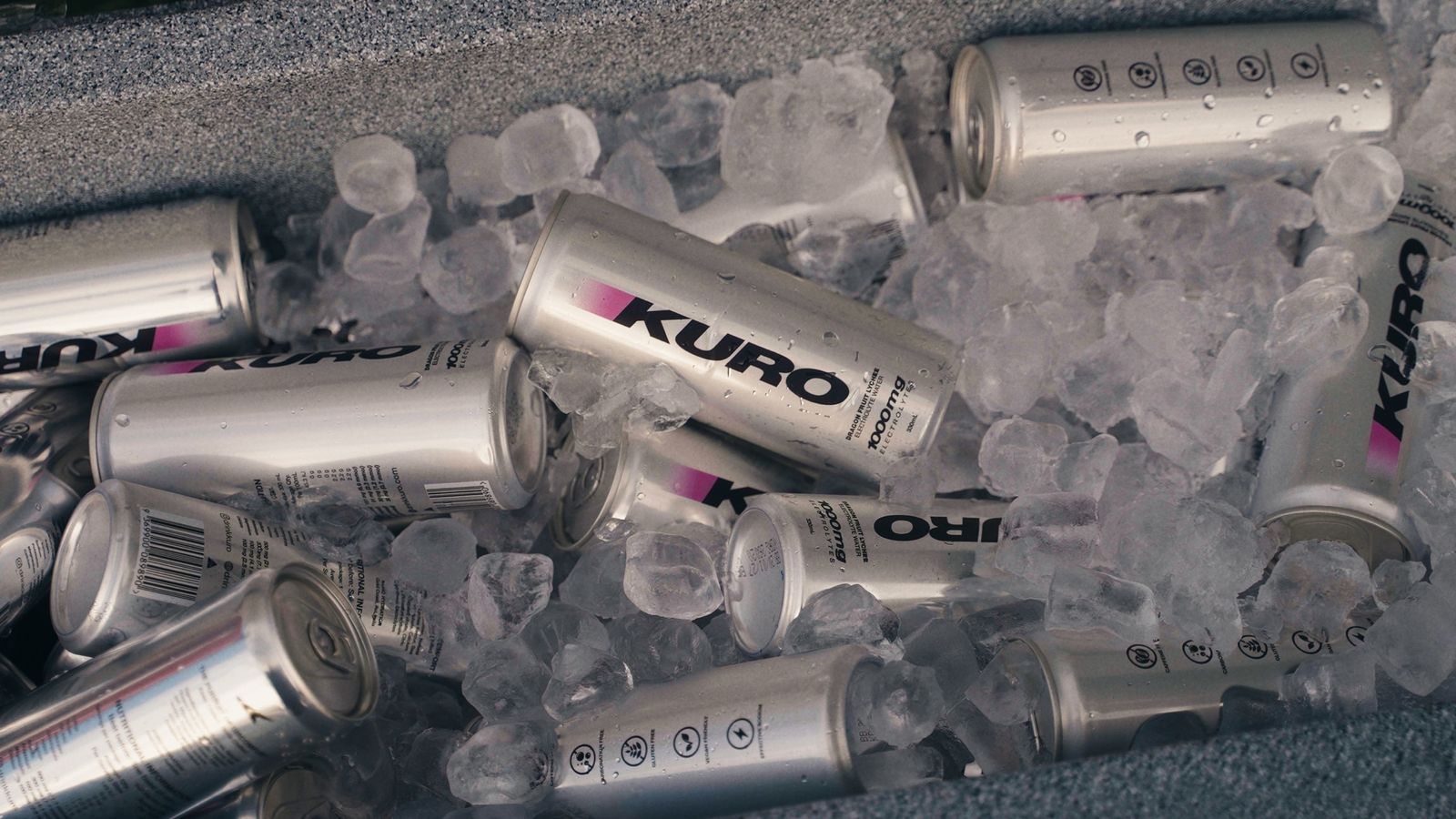
A 330ml can of KURO carries 500mg of sodium, plus 300mg potassium, 100mg magnesium and 100mg calcium. For most people that covers a reasonable chunk of a solid hour. For a long hot session, one during and one after is closer to the mark.
For context on what's normal in the category: Australian sports drinks typically carry 23 to 69mg of sodium per 100ml.3 KURO carries 152mg per 100ml. A 600ml bottle at the low end of the category gives you under 140mg for the whole bottle, which is a fraction of what an hour in the heat takes out.
A rough practical approach
- Under an hour, cool conditions: water is usually fine.
- An hour or more, or sweating hard: put sodium in alongside the fluid.
- Hot day, back-to-back sessions, or you're a salty sweater: more sodium than you think, and keep going after you stop.
The short version
- Sweat rate: 0.5 to 2.0 litres an hour.
- Sweat sodium: roughly 230 to 2,070mg per litre, about a tenfold spread between people.
- One hard hour can cost a few hundred milligrams of sodium, or a few thousand.
- Across a hot day, active people can lose 3,500 to 7,000mg.
- One KURO can puts 500mg back.
You can't manage what you never bothered to measure. Start with the range, then work out where you sit in it.
Next: why sodium comes first, and what changes when it's 32 degrees.
References
- Baker LB (2017). Sweating rate and sweat sodium concentration in athletes: a review of methodology and intra/interindividual variability. Sports Medicine 47(Suppl 1):111–128. PubMed
- Shirreffs SM, Sawka MN (2011). Fluid and electrolyte needs for training, competition, and recovery. Journal of Sports Sciences 29(sup1):S39–S46. PubMed
- Healthy Food Guide (Australia). Guide to sports drinks, updated July 2025. healthyfood.com