Hydration
Why sodium comes first in an electrolyte drink
Sodium is the mineral that decides whether the water you drink stays in you. Here's what it does, how much you lose, and what a dose that actually replaces it looks like.
Most people have had the afternoon where they drank water all day and still felt flat. Dry mouth, heavy head, a session that felt harder than it should have. The obvious answer is that you didn't drink enough. Usually that isn't it.
Water tells you nothing about where it ends up. Sodium does. It's the mineral that decides whether what you drink gets absorbed and held, or passes straight through you. That's why it comes first in this formula, and why we talk about the dose before we talk about the flavour.
What sodium actually does
Sodium is the main electrolyte in the fluid outside your cells, and it's the one your body uses to move water around. In practical terms it does two jobs.
The first is absorption. Sodium is carried across the wall of your small intestine, and water follows it. That's the step plain water skips, and it's the reason rehydration drinks have carried salt for decades.
The second is retention. Once the fluid is in you, sodium is what keeps it there instead of going straight out again. The research is blunt about this: the fraction of fluid you retain after drinking is directly related to how much sodium you drank with it.2 Drink more sodium, keep more water.
How much you actually lose
This is where most hydration advice falls over, because the honest answer is that it varies enormously between people.
Sweat rates in athletes sit between roughly half a litre and two litres an hour. The sodium in that sweat ranges about tenfold, from around 230mg to over 2,000mg per litre.1 Two people can finish the same session having lost wildly different amounts of salt, which is why one of them cramps and the other doesn't.
Across a hot day, active people can lose somewhere between 3,500mg and 7,000mg of sodium.2 That's not a number you replace with one drink, and we're not going to pretend otherwise. It's a number that explains why a token amount of sodium in a 600ml bottle doesn't move the needle.
If you want the maths on your own session, we've broken it down in how much sodium you actually lose in a session.
Why drinking more water can make it worse
When you sweat, you lose water and salt together. If you replace only the water, the sodium that's left in you is spread through more fluid than before. Concentration drops. Your body reads that and starts getting rid of the excess, which is why you can drink all afternoon, spend the day going to the toilet, and still feel drained.
It's not that water is bad. It's that water alone is an incomplete answer after a session that took salt out of you.
What a useful dose looks like
Here's the part that's easy to check for yourself. Turn the can or bottle around and read the sodium figure per 100ml, not per serve. Per serve is the number brands prefer, because a bigger bottle makes a small dose look generous.
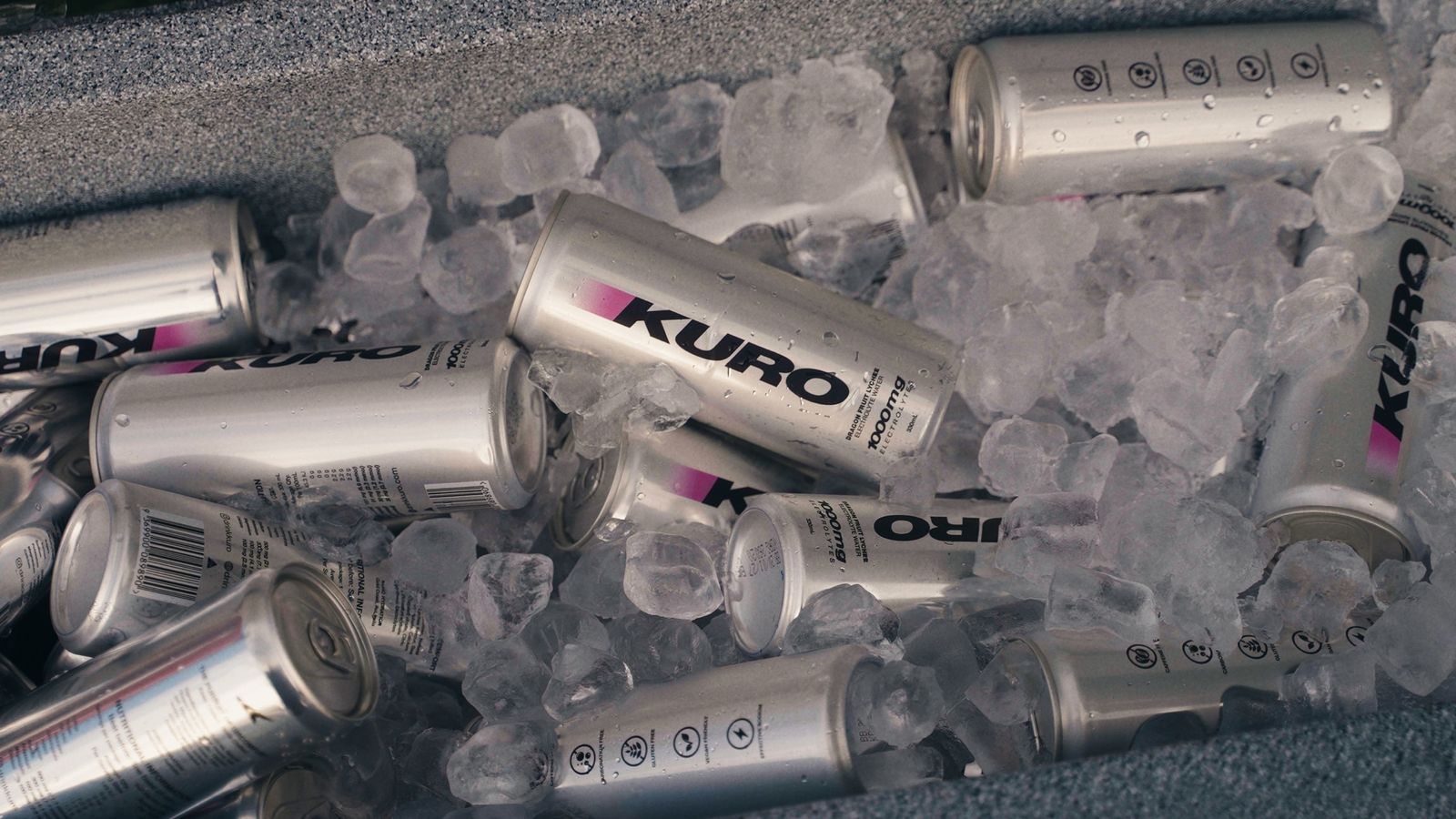
In Australia, sports drinks typically carry between 23mg and 69mg of sodium per 100ml.3 KURO carries 152mg per 100ml, which is 500mg in a 330ml can. That's two to six times the category, in a smaller serve.
We didn't land on 500mg because it sounded impressive. We landed on it because the amount you lose in a hard or hot hour is measured in hundreds to thousands of milligrams, and anything under a few hundred is a gesture rather than a replacement.
Sodium doesn't work alone
Sodium moves fluid into your bloodstream. Potassium moves it into your cells. Magnesium and calcium keep muscles contracting and relaxing properly. Dose the first one and ignore the other three and you've done part of the job, which is why a KURO can carries 500mg sodium, 300mg potassium, 100mg magnesium and 100mg calcium: 1000mg of electrolytes in total.
The short version
- Sodium drives absorption across the gut, and water follows it.
- How much fluid you keep is directly related to how much sodium came with it.
- Sweat sodium losses vary about tenfold between people, so generic advice misses badly.
- Read sodium per 100ml, not per serve.
- Australian sports drinks: 23 to 69mg per 100ml. KURO: 152mg per 100ml.
Water hydrates. Sodium is what makes it stay.
References
- Baker LB (2017). Sweating rate and sweat sodium concentration in athletes: a review of methodology and intra/interindividual variability. Sports Medicine 47(Suppl 1):111–128. PubMed
- Shirreffs SM, Sawka MN (2011). Fluid and electrolyte needs for training, competition, and recovery. Journal of Sports Sciences 29(sup1):S39–S46. PubMed
- Healthy Food Guide (Australia). Guide to sports drinks, updated July 2025. healthyfood.com